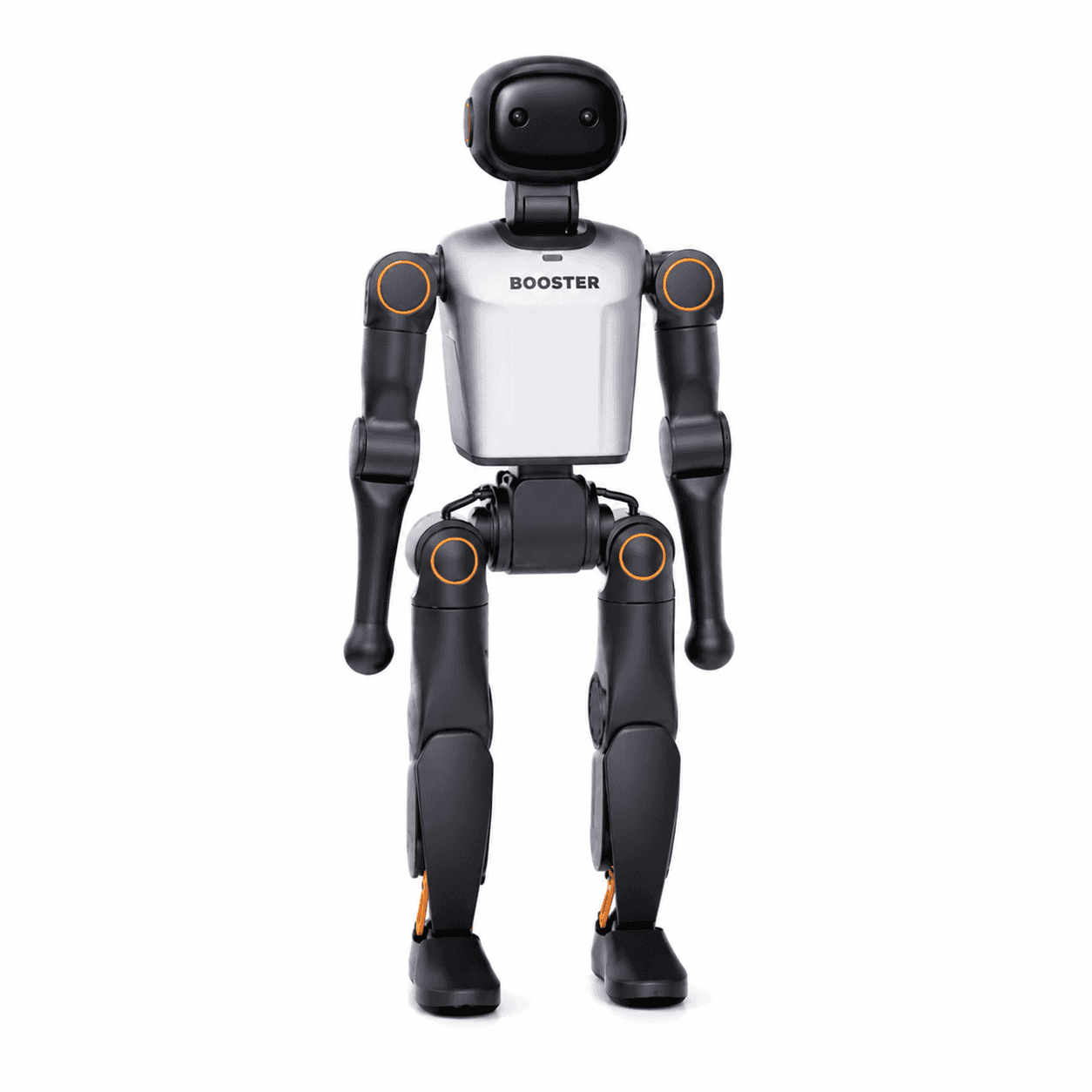
Booster K1
RoboCup-winning humanoid platform for embodied AI education and research
The Booster K1 is a compact bipedal humanoid robot from Booster Robotics, a Beijing-based company founded by members of Tsinghua University's robot control and RoboCup teams. Standing about 95 cm tall and weighing roughly 19.5 kg with 22 degrees of freedom, it is positioned as an entry-level embodied-intelligence development platform for education, research, and demonstration.
22 degrees of freedom (6 per leg, 4 per arm, 2 head)
Up to 200 TOPS onboard AI compute (Pro edition)
RoboCup 2025 Soccer KidSize champion
60 N·m peak joint torque, force-controlled dual-encoder joints
Stereo depth camera, 9-axis IMU, 6-mic array
What it does
The K1 walks on full force-controlled, dual-encoder joints (peak torque 60 N·m) at a typical pace around 0.4 m/s, and perceives its surroundings through a stereo/3D depth camera, a 9-axis IMU, and a microphone array with speaker. Onboard compute scales by edition, from 48 TOPS (Geek) to 117 TOPS (Edu) to 200 TOPS (Pro), and the platform supports development in Python, ROS, and ROS2 with API/SDK access plus OTA firmware upgrades. It ships with the Doubao LLM included for six months and integrates with Booster's reinforcement-learning and sim-to-real toolchain for custom locomotion and behavior.
Where it's used
The K1 is built for higher-education labs, engineering schools, and robotics research groups working on bipedal locomotion, computer vision, and human-robot interaction. It served as the competition platform in the RoboCup 2025 Soccer KidSize league, where it took both the championship and runner-up positions, and it has appeared at events such as the 2025 World Humanoid Robotics Games. Its lighter weight and lower price relative to full-size humanoids make it practical for classroom use, student projects, and technical demonstrations.
Why operators choose it
RoboCup 2025 KidSize champion platform, validated in real competition
Scalable compute from 48 to 200 TOPS to match budget and workload
Open development on Python, ROS, and ROS2 with SDK access
Compact 19.5 kg form factor that is easy to deploy in classrooms and labs
Lower entry cost than full-size humanoids for teaching and R&D
Specifications.
- Dimensions
- ~950 H × ~300 W
- Weight
- ~19.5 kg
- Max Speed
- Walking 0.4 m/s typical
- Total DoF
- 22
- Leg DoF
- 6 (per leg)
- Arm DoF
- 4 (per arm)
- Waist / Head DoF
- Head: 2
- Battery Capacity
- 2 Ah (Geek) / 5 Ah (Edu/Pro)
- Runtime
- 30 min (Geek) / 80 min (Edu/Pro) @ 0.4 m/s
- Charging Time
- Supported
- Navigation & Sensors
- Stereo Depth Camera, 9-axis IMU, Circular 6-Mic Array
- Computing & AI
- 48 TOPS (Geek) / 117 TOPS (Edu) / 200 TOPS (Pro)
- Connectivity
- Wi-Fi 6, Bluetooth 5.2, Gigabit Ethernet
- Additional Specs
- Max Peak Torque: 60 N·m
- Dual Encoder joints
- RoboCup 2025 KidSize Champion
- LLM (Doubao) included free 6 months
- OTA upgrades
Specifications sourced from the manufacturer. View official product page. Variant-specific figures may apply; contact us to confirm the exact configuration.
See the Booster K1 in action.
Book a private demonstration or request a pilot tailored to your operation.
Book a Demo