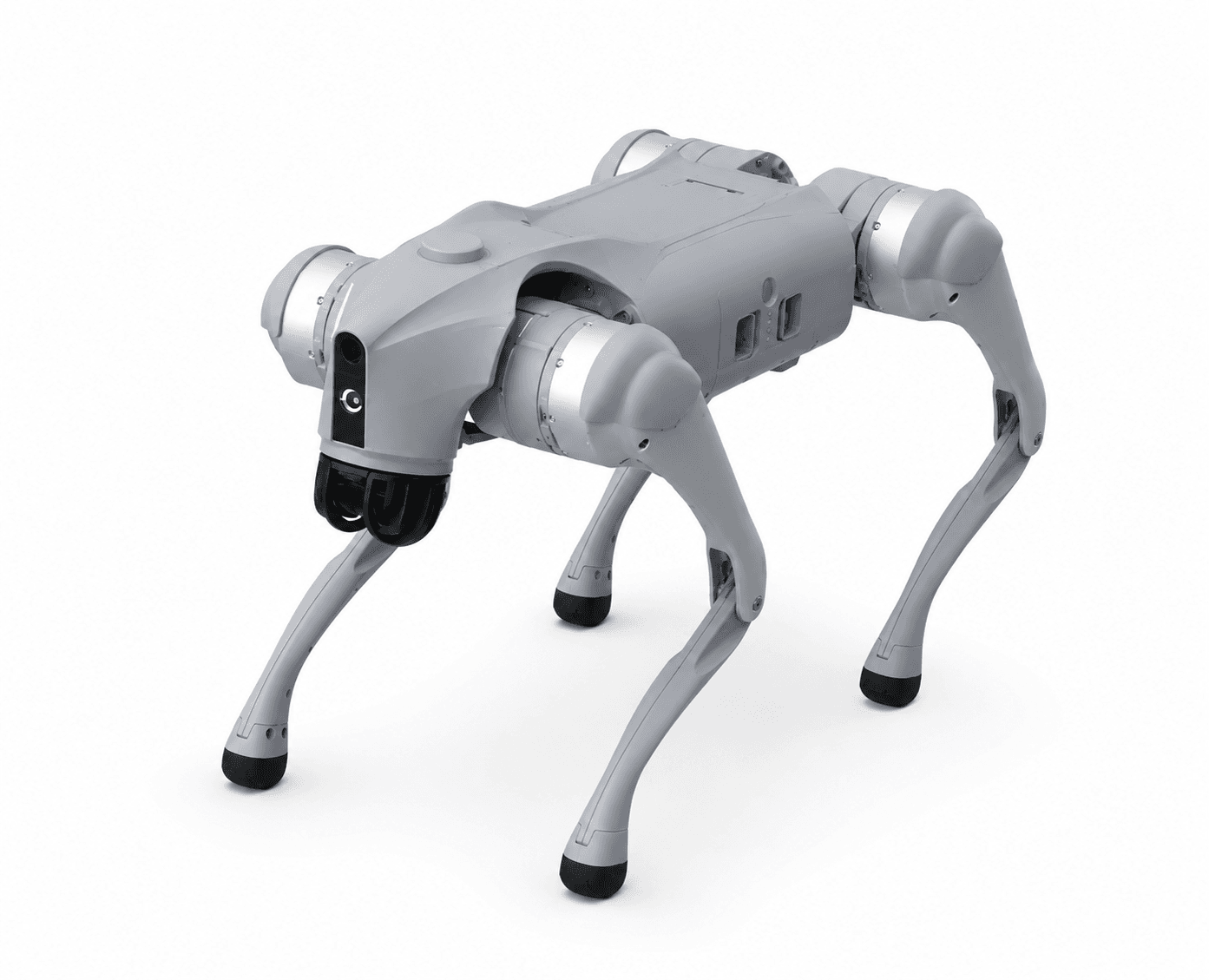
Go2
Agile four-legged robot for inspection, education and research
The Unitree Go2 is a 12-degree-of-freedom quadruped ("robot dog") built by Unitree Robotics. It is a compact, all-terrain legged platform aimed at inspection, education and research, available in Air, Pro, X and EDU configurations with progressively more compute, connectivity and developer access.
4D LiDAR L2 with 360x96 hemispherical coverage, 0.05 m min. range
12 joints / 12 DoF (3 per leg) for agile legged locomotion
Max speed up to 5 m/s on X variant (2.5 m/s Air, 3.5 m/s Pro)
Max climb angle of 30-40 degrees
ISS 2.0 side-follow with 30 m+ remote range and 3D LiDAR mapping
What it does
The Go2 walks, climbs and balances on uneven ground using 12 joint motors (three per leg) and a control system that supports advanced gaits such as obstacle climbing, roll-over recovery and even upside-down walking. It perceives its surroundings with Unitree's 4D LiDAR L2, giving 360x96-degree hemispherical coverage with a 0.05 m minimum detection distance, plus an HD wide-angle camera, enabling 3D LiDAR mapping and intelligent obstacle detection and avoidance. The ISS 2.0 intelligent side-follow system lets it accompany an operator and accept remote control at 30 m or more, while OTA updates keep the platform current. EDU and higher variants add force sensors, depth camera, more onboard compute and full secondary-development (SDK) access for research.
Where it's used
Unitree positions the Go2 for inspection, education and research, and its sensing, mapping and developer tooling make it suitable for routine facility and infrastructure inspection, robotics teaching, and academic research into legged locomotion and embodied AI. The EDU configuration, with force sensors, a depth camera, extended battery and SDK access, is the variant geared toward universities, labs and integrators building custom autonomy applications. As a reseller deployment, it serves as an entry-level, all-terrain mobile platform that can carry sensors into environments that wheeled robots cannot easily reach.
Why operators choose it
All-terrain mobility on stairs, slopes and obstacles where wheeled robots struggle
Built-in 4D LiDAR and camera give 3D mapping and obstacle avoidance out of the box
Open SDK and graphical programming on EDU/X variants for custom autonomy and research
Compact ~15 kg form factor that is easy to transport and deploy
OTA updates and tiered variants let buyers scale from pilot to development
Specifications.
- Dimensions
- 700 L × 310 W × 400 H (standing)
- Weight
- ~15 kg
- Max Speed
- 2.5 m/s (Air) / 3.5 m/s (Pro) / 3.7 m/s MAX 5 m/s (X)
- Payload
- ≈7–8 kg (≤10–12 kg max)
- Total DoF
- 12 joints (3 per leg)
- Battery Capacity
- 8,000 mAh (std) / 15,000 mAh (EDU)
- Runtime
- 1–2 h (std) / 2–4 h (EDU)
- Charging Time
- 33.6V 3.5A (std) / 33.6V 9A fast (EDU)
- Navigation & Sensors
- 4D LiDAR L2 (360°×96°), HD Wide-angle Camera, Foot-end force sensor (EDU), Wireless Vector Positioning
- Computing & AI
- 8-core High-performance CPU; optional Orin 40–100 TOPS (EDU)
- Connectivity
- Wi-Fi 6, Bluetooth 5.2/4.2/2.1, 4G (GPS)
- Additional Specs
- Peak joint torque: ~45 N·m
- Max climb angle: 30°–40°
- Max climb height: 15–16 cm
- ISS 2.0 side-follow
- OTA upgrades
- 3D LiDAR mapping
Specifications sourced from the manufacturer. View official product page. Variant-specific figures may apply; contact us to confirm the exact configuration.
See the Go2 in action.
Book a private demonstration or request a pilot tailored to your operation.
Book a Demo